A lightweight carbon-fiber landing gear with an intentional breakaway section, validated with orthotropic linear-static FEA.
- FOS at 1g
- 3.81
- Stress change on refinement
- 1.22%
Problem
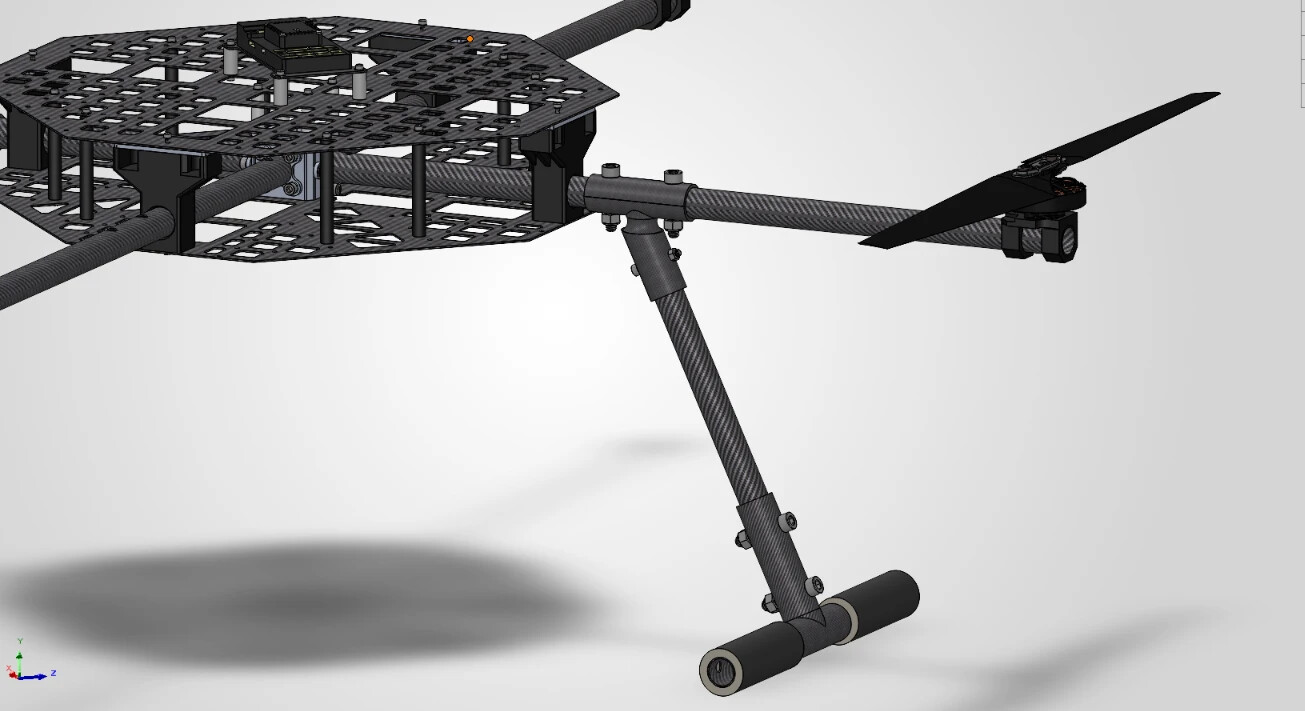
- Design a lightweight landing gear assembly for Pegasus 1 while maintaining structural integrity under landing loads.
- Incorporate a controlled breakaway feature to protect the aircraft structure during high-impact landings.
Approach
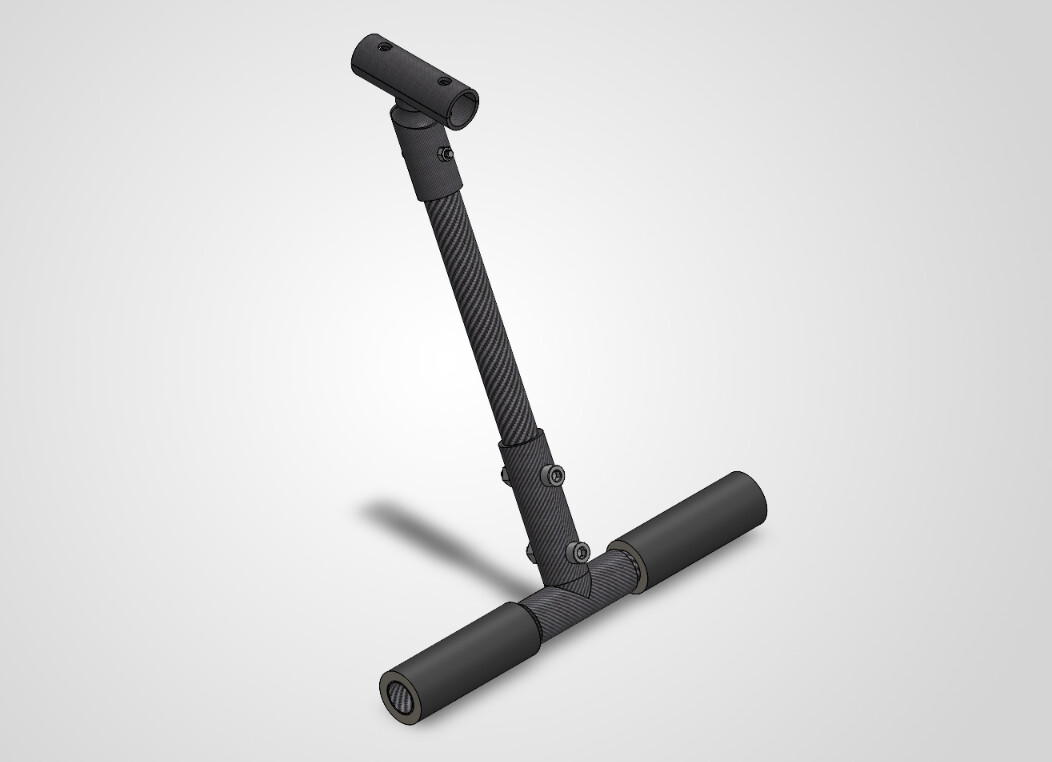
- Designed the complete landing gear assembly in SolidWorks using 22 mm OD carbon-fiber tubes and a 3D-printed PETG-CF bracket.
- Modeled the bracket in isolation and ran orthotropic linear-static FEA across a 1-4g load sweep.
- Analyzed stress and deformation to identify critical regions and validate the controlled breakaway joint.
Result
- Achieved a 3.81 factor of safety at 1g normal landing loads.
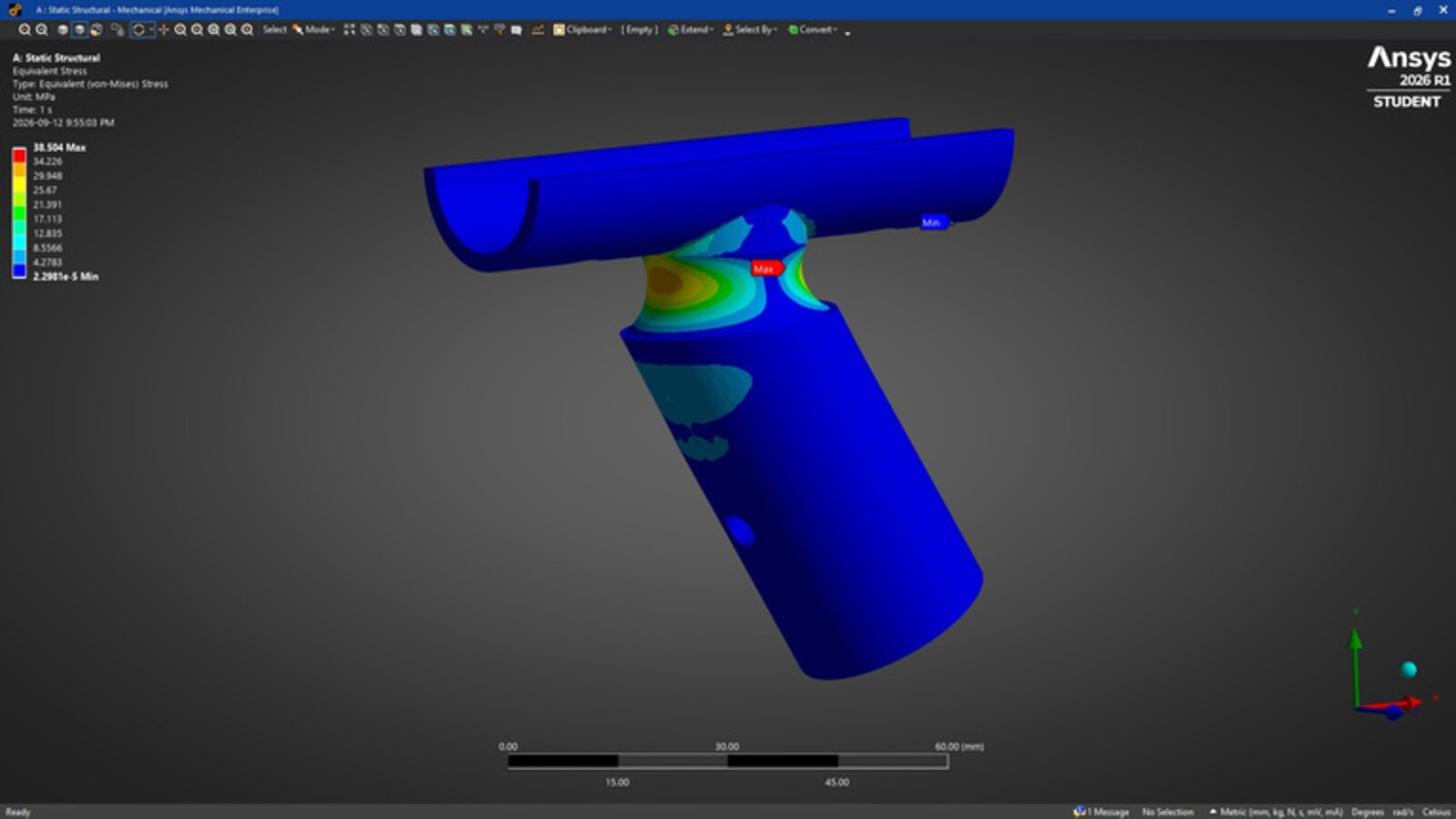
- Predicted tensile-failure onset at the hourglass neck at 4g, confirming the joint fails before the primary carbon-fiber tubes are overloaded.
- Mesh refinement around bolt interfaces changed peak stress by only 1.22% (37.33 to 37.79 MPa), confirming convergence.
Design
The Pegasus 1 landing gear uses 22 mm OD carbon-fiber tubes and a 3D-printed PETG-CF bracket. The bracket includes an intentional breakaway section with an hourglass neck, so that in a hard crash the sacrificial joint fails before the primary airframe or carbon-fiber tubes are overloaded.
FEA validation
I modeled the bracket in isolation and ran orthotropic linear-static FEA under a 1–4g load sweep (4g = 196.2 N). At 1g normal landing loads the bracket has a 3.81 factor of safety. At 4g the analysis predicts tensile-failure onset at the hourglass neck, which is the intended sacrificial failure.
Mesh convergence
I refined the mesh around the bolt interfaces and the breakaway region. Peak maximum principal stress moved from 37.33 to 37.79 MPa, a change of only 1.22%, which confirms the result is mesh-converged.
Related work
I also designed a 3D-printable protective enclosure for an APD 120F3 ESC, with M3 mounting interfaces, component clearances, passive ventilation, and terminal protection.